

You need a marketing consultant when you can’t tell what to prioritize, your website and social media tell different stories, or you’re making marketing decisions without a clear goal. If you already know what you need and simply need someone to do it, hands-on support is the better fit. A consultant helps you sort out that distinction before choosing more work.
- How do I know if my small business needs a marketing consultant? Look for unclear priorities, disconnected messaging, and unresolved decisions.
- Choose marketing strategy help for direction; choose hands-on support when the task is already clear.
- Purple Essence offers tailored digital marketing guidance, with a consult as the preferred first step.
- A digital presence audit examines what needs attention; strategy helps you decide what to do about it.
I’m Kathy G. Through Purple Essence, I help women and creatives who own brands think through their digital presence. You know your craft. My role is to help you connect that expertise with what people see and understand online.
How do I know if my small business needs a marketing consultant?
Look at the decision you’re stuck on, not how busy your marketing feels. A full calendar of posts doesn’t answer whether those posts support the right goal. An unfinished website doesn’t automatically mean you need a new strategy, either.
For your 2027 marketing decisions, use this distinction: do you need direction, a closer look at your current presence, or help completing a defined task?
| Option | Best for | What it helps you do | Limitation |
|---|---|---|---|
| Marketing consultant | Owner who is unsure what to prioritize | Connect goals, audiences, messaging, and channel choices | Advice still needs someone to carry it out |
| Digital presence audit | Owners who want their current presence examined | Identify issues and questions across existing touchpoints | Findings aren’t the same as an ongoing plan |
| Hands-on support | Owners with a clear task and direction | Complete agreed work, such as website updates or content | Completing tasks doesn’t settle an unclear strategy |
| Working independently | Owners who can identify and address a specific problem | Make a focused change and assess it | You’re responsible for both the decisions and the work |
These options aren’t a ladder you have to climb. Choose the help that matches the problem, and then ask what the actual work includes before agreeing to it.
Why this matters
When something feels off, it’s tempting to add something: another platform, another course, another round of posts. I’d rather help you name the problem first. More activity isn’t a substitute for knowing what that activity is meant to accomplish.
You’ve put real work into your brand. You don’t need to become a marketing specialist to ask good questions, and you don’t have to hand over every decision to a consultant or Fiverr.
The useful question for 2027 isn’t whether you’re doing enough marketing. It’s whether your marketing gives customers a clear, connected way to understand your brand and take the next step.
Signs that you need direction rather than another task
You can’t explain what your marketing should accomplish
You might want more inquiries, more product interest, or clearer communication about a particular service. Those are different goals. Before choosing a platform or campaign, decide on the goal.
Ask yourself: if my marketing worked as intended, what would a customer do next? If you can’t answer that, start with direction rather than a production schedule.
Your website and social media describe different brands
Read your homepage beside your social media bio. Do they describe the same audience, offer, and next steps, or would someone need to piece the story together?
Different platforms shouldn't have identical wording. However, they do need to make sense together. A friendly social presence and a more detailed website can work well without sounding like unrelated brands.
You keep revisiting the same decisions
Should you rewrite the homepage, post more often, change platforms, or start an email list? When you keep circling those questions, collecting more ideas doesn’t give you a way to choose among them.
I’d start by connecting each idea to your goal and capacity. Keep a place for interesting ideas, but don’t treat every idea as a new commitment.
People can see your work but can’t see how to hire you
For a creative or service-based brand, showing the work is only part of the job. Your website also needs to explain who the work is for and how someone can inquire about it.
My guide to a creative business website beyond a portfolio explores that distinction. Beautiful examples deserve a clear path to the next conversation.
Check your digital presence before choosing help
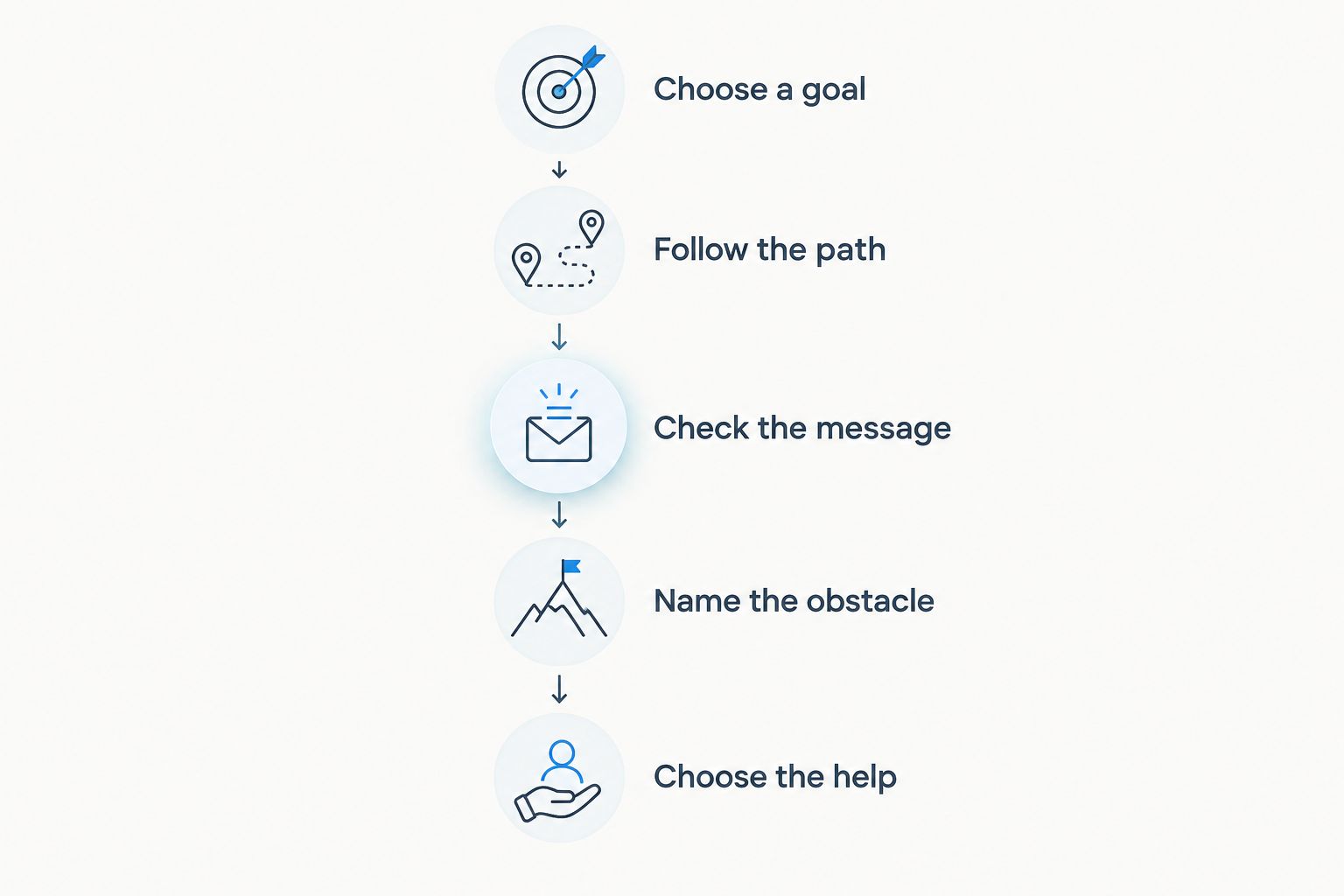
You don’t need a formal report to start noticing where the confusion lives. Try this review using the pages and profiles customers can actually reach today, not the version you’re planning to publish later.
1. Choose a goal
Write down the customer action you want your marketing to support. Be specific enough that you can recognize it: an inquiry about a service is clearer than simply wanting more attention.
Keep this goal visible as you review the rest. Otherwise, it’s easy to drift into preferences about fonts or posting formats instead of the problem you meant to solve.
2. Follow the path
Start where someone might encounter your brand, such as a social profile, and follow the link to your website. Check whether the destination continues the same conversation.
Does the person arrive somewhere relevant? Can they understand the offer without searching through unrelated pages? Note the point where the path becomes confusing rather than immediately planning a complete redesign.
3. Check the message
Read the page as someone who doesn’t know your work. Look for a clear explanation of what you offer, whom you help, and why someone would choose that offer for their situation.
Your expertise doesn’t need to disappear into simplified language. The aim is to make that expertise understandable without asking the reader to translate unfamiliar terms.
4. Name the obstacle
Describe the problem in plain language. For example: your social profile describes a service that the linked page doesn’t explain, or the website shows finished work without explaining how to inquire.
Those are useful starting points. A broad statement such as everything needs fixing makes it much harder to choose the right kind of help.
5. Choose the help
If the obstacle is clear and the solution is straightforward, you can decide whether to handle it yourself or hire hands-on support. If you’re still unsure which problem matters most, discuss that uncertainty in a consult with me.
For a 2027 review, keep your notes tied to your current offer and current capacity. An old plan isn’t automatically the right guide for what your brand needs now.
Why the right kind of marketing help varies
The same recommendation doesn't fit every brand. I start by using these factors to shape the conversation rather than assume you need a standard package:
- Your immediate goal. Clarifying a service offer is a different assignment from planning how to introduce a product.
- The state of your website. A clear website with an isolated issue needs a different discussion from a site whose purpose is unclear.
- Consistency across channels. Conflicting messages need attention before you repeat them in more places.
- Your capacity. A plan needs to account for the work you can realistically maintain or delegate.
- Your need for guidance versus delivery. Decide whether you want help choosing the work, completing it, or both.
You’re the boss. A useful conversation should make those choices easier to understand, not leave you feeling that you need every service on a list.
When should I keep handling marketing myself?
Keep handling marketing yourself when you can name the problem, choose a sensible change, assess what happens next, AND can make the changes quickly. You don’t need outside help just because you’re doing the work yourself, but you also don't need to take on learning a new tool.
For example, an outdated service description is a defined editing task if you already know what the description should say. Uncertainty about which service to emphasize is a strategy question. Be honest about which situation you’re in.
Should I get a digital presence audit first?
Choose an audit when you want a focused examination of your existing digital presence. Choose a consult first when you’re unsure whether an audit, strategy work, or a specific task will address your concern.
An audit and a strategy serve different purposes. An audit identifies what needs attention; a strategy connects decisions and actions to a goal. Ask how findings will be explained and what support, if any, follows the report.
What should I bring to a marketing consult?
Bring your website, the social profiles you use, your main goal, and the decision that keeps getting pushed aside. You don’t need a polished presentation. Plain notes about what feels disconnected are enough to give the conversation a starting point.
For a useful 2027 consult, I’d also encourage you to explain what you can do yourself. A plan that ignores your available time or your willingness to use a profile or tool doesn’t get you the answers or updates your brand may need.
What working with Purple Essence starts with
Purple Essence is best for women brand owners and creatives who want tailored guidance connecting their website, social media, and messaging. My preferred starting point is a consult so we can talk about your brand before deciding whether an audit or strategy work fits.
That approach gives us room to discuss what you need without treating every concern as the same assignment. Direct audit inquiries are welcome, too. You don’t have to arrive with the service already chosen.
Consulting also has a boundary: deciding what to do isn’t the same as completing every task. If you need someone to carry out the work, make that part of the conversation and clarify the scope rather than assume it’s included.
Request a consult
Chat with Kathy G about your brand before choosing an audit or strategy work.
FAQ
How do I know if my small business needs a marketing consultant?
You need a marketing consultant when unclear goals, competing priorities, or disconnected messaging keep you from choosing your next step. If you already know the task and how it supports your goal, hands-on support is a better fit.
Do I need a consultant if I already post on social media?
Posting on social media doesn’t settle whether you need strategic help. Look at whether your posts support a clear goal and lead people to your website that explains the same offer.
Is a digital presence audit the same as marketing strategy?
A digital presence audit examines what currently needs attention; marketing strategy guides what to prioritize and why. Ask whether a proposed service includes findings, recommendations, implementation, or a defined combination.
Can I keep doing my own marketing after hiring a consultant?
You can keep doing your own marketing while getting help with decisions. Clarify who will complete the work and what guidance you’ll receive before agreeing to the scope of work.
Does my brand need to be local to work with Purple Essence?
Your brand doesn’t need to be local to work with Purple Essence. Kathy G works with owners worldwide, including women with product-based and service-based brands and people in creative fields.
What should I ask before hiring a marketing consultant?
Ask what problem the work addresses, what’s included, and who will carry out the recommendations. You should also understand how the proposed approach fits your goals and available capacity.
Should I request a consult or ask directly for an audit?
Request a consult if you want to talk through your situation before choosing the work. Direct audit inquiries are also welcome when you already know you want your digital presence examined.
One last thing
Before adding another marketing commitment in 2027, write this sentence: I want someone who finds my brand to understand ___ and then ___. Fill both blanks.
If that feels surprisingly difficult, don’t take it as a failure. It’s a useful place to begin our conversation. You don’t need more polished marketing language; you need a clear decision about what your marketing is there to do.
Related guides
- How much does a small business marketing consultant cost?
- Before you buy another marketing course
- Why a realtor website needs more than listings
Recent Comments