

Your small business should budget for marketing based on what you can consistently afford after operating costs, the customer action you want to attract, and the work needed to make that action easier. For 2027, I recommend financing a focused plan rather than choosing an arbitrary percentage of revenue (which is what most of my clients do)—and counting your own time alongside the money you spend.
- How much should a small business budget for marketing? Create a focused plan your cash flow can support.
- Purple Essence’s digital marketing strategy starts with your brand’s needs, not a standard spending percentage.
- Always include website audits and upkeep, content production, outside support, and your own time in your marketing budget.
- Choose a clear customer action before deciding which channels deserve time and money.
How much should a small business budget for marketing in 2027?
Budget for the work your brand needs, within a limit your cash flow can support. A revenue percentage alone doesn't tell you whether your website explains your offer, what platform your customers use, or if you have time to follow through.
I'm Kathy G. Through Purple Essence, I help small business owners connect their website, social media, and messaging with a strategy that fits their brand. You've put real work into what you do; your marketing plan should show that work, not become another source of frustration.
Here's the planning sequence I'd use before committing to spending:
- Set your spending limit. Look at the money available after essential operating costs and the cushion you need to avoid stress.
- Choose the customer action. Decide whether your immediate priority is an inquiry, a purchase, a booking, or another action relevant to your brand.
- Scope the work. Identify what's preventing that action, then decide what you can handle and where you need help.
The order matters. Starting with a service package or advertising plan can leave you trying to fit your brand around somebody else's offering.
Why this matters
A marketing budget is a set of choices about money, attention, and follow-through. It isn't just the amount you pay someone else.
If you're a woman running a product-based or service-based brand, you might also be creating the products, serving clients, managing orders, and answering emails and texts. A plan that assumes unlimited content time doesn't fit that reality.
For your 2027 plan, ask a more useful question alongside the headline question: What can I maintain without taking resources away from delivering good work? That gives you a boundary for choosing both paid help and tasks you'll be able to keep for yourself.
You don't need to be everywhere. You just need a clear reason for the places you choose.
Build your budget around the work, not the channel
Separate your plan into 4 budget categories: direction, foundations, ongoing work, and distribution. These aren't mandatory categories, but they are a way to see what you're actually committing to.
| Budget category | Best for | What to include | Limitation to consider |
|---|---|---|---|
| Direction | Owners who need to decide what matters first | Planning, reviewing priorities, defining the customer action | A plan still needs someone to carry it out |
| Foundations | Brands whose website or messaging creates confusion | Website updates, clearer offer descriptions, working inquiry or purchase paths | Improvements need maintenance as your brand changes |
| Ongoing work | Owners who need consistent communication | Copy, images, publishing, email prep, responding | Recurring tasks require consistent time or support |
| Distribution | Brands with a clear message and destination | Paid promotion, campaign management, campaign materials | Paying for attention doesn't fix an unclear offer |
Direction: decide what deserves attention
Before paying for more activity, write down what you want your marketing to help customers understand or do. Be specific enough that you can tell whether a proposed task belongs in the plan.
For example, explaining a new service is a different assignment from helping existing customers find care instructions. Both involve communication, but they don't call for identical work.
My recommendation: fund clarity before adding activity. The trade-off is that planning takes attention away from publishing immediately. That's a useful trade when you're not yet sure what the publishing should accomplish.
Foundations: make the next step understandable
Read your main website pages (3-4 main ones) as someone who doesn't know your brand. Can you identify what you offer, who it's for, and what to do next?
If the answers aren't clear, include that work in the budget before sending more people to those pages. The same applies to an inquiry form that doesn't work or instructions that contradict your social profiles.
Foundation work has a limit, too. You can keep polishing indefinitely, but defining the problem you're fixing ensures the plan has a practical stopping point.
Ongoing work: account for the work after publishing
A social post isn't finished simply because it's published. Your plan also needs room for answering questions, checking your analytics (no matter how small), and keeping the destination page current.
You might keep these tasks to complete yourself or arrange outside support (like me!). Either way, write down who owns them. A budget without an owner for recurring work leaves a gap that money alone won't close.
Distribution: promote something ready to receive attention
Paid promotion belongs in the same plan as the message and the page it leads to. Treating those as separate decisions makes it harder to understand what you're asking the campaign to accomplish.
If you're considering promotion in 2027, decide how you'll recognize a relevant inquiry or completed purchase before spending. More visits aren't the same thing as the customer action you chose.
Why your marketing budget varies
Different brands need different work. That's why I wouldn't tell a product maker, a service provider, and an artist to copy the same spending plan.
These factors help explain what belongs in yours:
- Your current website. Clear, current pages require different work from pages that no longer describe what you sell.
- Your offer. A service that starts with a conversation needs a different customer path from a product someone can purchase directly.
- Your available time. Handling marketing yourself changes where money goes, but the work still takes time.
- Your existing materials. Useful photography, clear descriptions, and current information affect what needs creating next.
- Your chosen channels. Each channel adds preparation, publishing, and response responsibilities.
- Your capacity to serve customers. Marketing commitments need to fit the work you can actually deliver.
These are planning questions, not reasons to buy everything. Sometimes the right decision is to narrow the plan until it works best for you.
Turn those choices into a workable plan
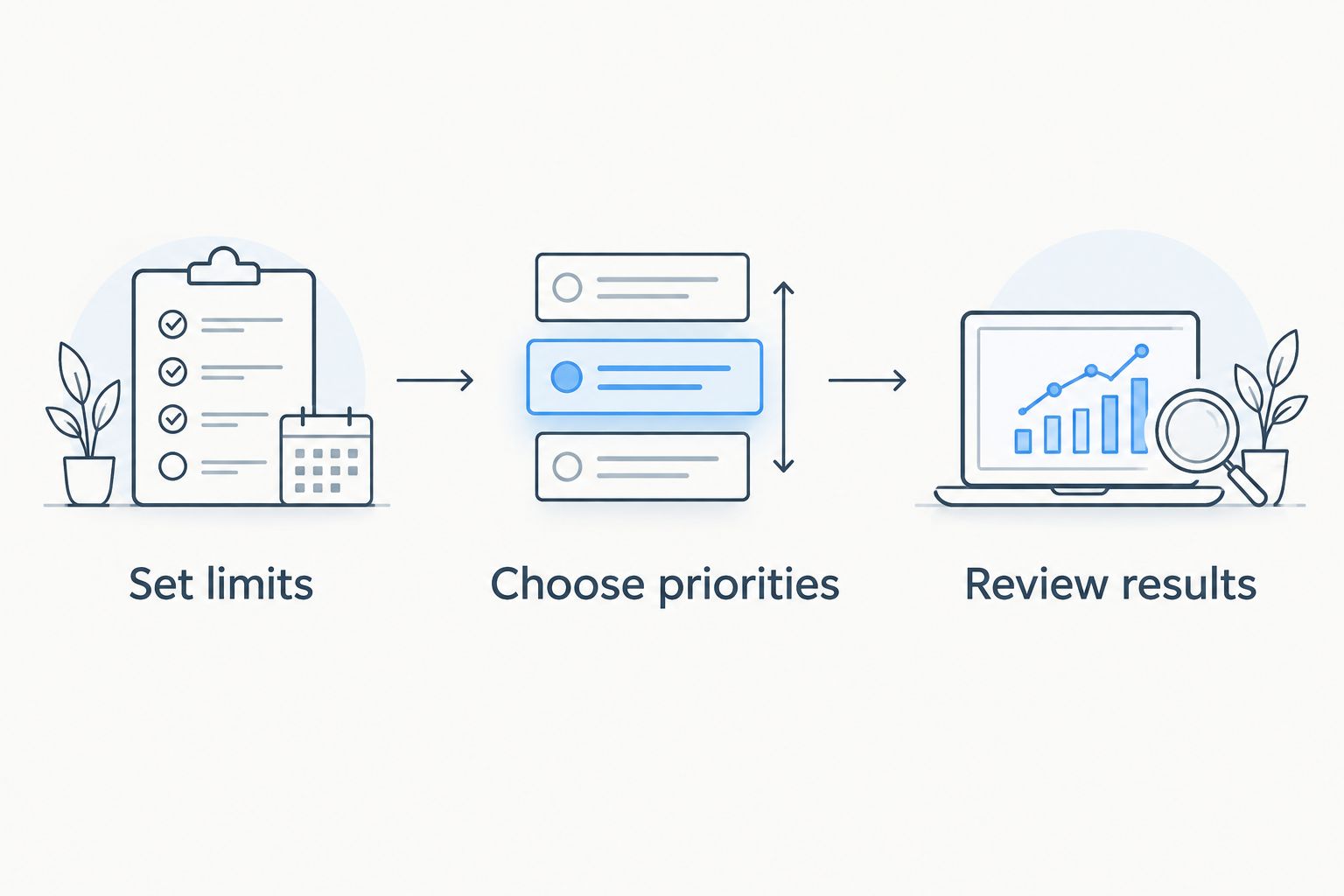
I suggest using 3 planning steps: set limits, choose priorities, and review results. Keep the plan somewhere you'll actually use it, rather than creating a document that feels like homework.
Set limits
Write down what you can commit in money and time. Keep those limits separate so you don't mistake doing the work yourself and not tracking that time.
Use actual supplier proposals and your own calendar when filling in the details. A task that fits your spending limit but not your work week still needs adjusting.
Choose priorities
Pick the work most closely connected to your chosen customer action. If customers can't understand your service page, producing more posts about that service doesn't resolve the underlying problem.
Write the reason beside each proposed task. Something as simple as “clarify what's included before someone inquires” gives you a useful test when other ideas compete for attention.
Review results
Decide what you'll check before the work begins. Match that check to the task: a repaired form needs a submission test, while an inquiry campaign needs a way to identify relevant inquiries.
Don't require every task to prove the same thing. Keeping a product description accurate matters, but it isn't the same assignment as introducing your brand to new customers.
A useful 2027 budget should explain what you're doing, why it matters, who owns it, and what would make you reconsider. If you can't answer those questions, simplify the plan before expanding it.
Should I handle marketing myself or pay for help?
Keep the work you can do consistently and seek help with the decisions or tasks that are holding you up. You don't have to hand over everything to get useful support.
Doing your own marketing keeps you close to customer questions and gives you direct control over your message. The drawback is the time it takes away from other responsibilities, especially when you're learning a task as you go or you're a creative wanting to create.
Outside support can give a task a clear owner and bring relevant skills into the plan. It also requires your input: someone still needs accurate information about your offers, customers, and preferences.
For women small-business owners who want collaborative, tailored help, Purple Essence's digital marketing strategy is best for connecting your brand's website, social media, and messaging decisions. There's no substitute for your knowledge of your brand or your participation in the work, but adding a person who can help define things creates a flow and faster results.
You can explore my digital marketing strategy services when you're deciding what kind of support fits. I always prefer starting with a conversation rather than choosing an audit or strategy project before we understand what's needed. Many times it seems simple, but a few questions on a call can allow us to go deeper than just want's on an audit form.
Should I increase marketing spending when sales slow down?
A slower sales period is a reason to examine the customer path, not an automatic instruction to spend more. Start by separating what you know from what you're assuming.
Are people reaching the relevant page? Are inquiries arriving but not getting their questions answered? Has an offer changed without the website catching up?
Those questions point to different work. Buying more attention won't answer a question about whether your current offer is clearly explained.
Before changing your 2027 spending commitment, choose one next action you can connect to a specific problem. That gives you a clearer basis for deciding what to keep, change, or stop.
How do I know whether an audit belongs in my budget?
An audit belongs in the conversation when you need a closer look at how your digital presence works together. It can help organize questions about your website, messaging, and customer path, but a review isn't the same as implementing changes.
If you already know what needs fixing, practical implementation support might be the more relevant discussion. If you're unsure where the difficulty begins, that's when a conversation and audit helps.
At Purple Essence, my preferred first step is a consult. We can chat about your brand and decide whether an audit or strategy work fits; direct audit inquiries are welcome, too.
Let’s talk about your priorities
Tell me what’s feeling disconnected before you choose a plan of action.
FAQ
What percentage of revenue should I spend on marketing?
Choose a budget your cash flow can support and connect it to specific work rather than treating a revenue percentage as the answer. A percentage alone doesn’t account for your website’s condition, available time, or customer path.
What’s the best marketing budget for a brand that’s just getting started?
The best starting budget funds a clear offer, an understandable next step, and work you can maintain. Build from your actual operating commitments and supplier proposals instead of copying another brand’s spending.
Does my own time count toward my marketing budget?
Yes, your own time belongs in your marketing plan even when you aren’t paying a consultant. Track those responsibilities separately from cash spending so you can see whether the workload fits. Your time should note time you spend on the business (creating products, taking orders) and time you spend about the business (updating your website, being on social media, research).
Should I budget for social media before improving my website?
My answer? A solid No. Your website is your home. Definitely fix a confusing or broken destination before paying to send people there. You can keep communicating with your audience organically while prioritizing the website work needed to support social.
How do I decide whether paid advertising is worth budgeting for?
Start with a clear offer, a relevant destination, and a customer action you can track. Paid advertising has a distribution role; it doesn’t replace clear messaging or a working inquiry or purchase path. If you’re looking to advertise with a certain company or profile, contact an expert first before planning a budget. Many times inquiry calls are free.
What should I cut when my marketing budget feels stretched?
Start by reviewing commitments that don’t have a clear purpose, owner, or connection to your current priority. Protect essential upkeep and make sure a smaller plan still supports a usable customer path. Your analytics should give you a clear picture of what’s working and not.
Can I request an audit without a consult first?
You’re absolutely welcome to do that as I’ll be in touch after that request or direct purchase. However, I prefer starting with a phone or Zoom consult. Talking about your brand first helps us decide whether an audit or strategy work is the right fit. The first call is free and everyone walks away with a few tips they didn’t have before talking with me.
One last thing
Before adding anything to your budget, follow the path you're asking a customer to take. Open the social profile, follow its link, read the destination page, and check the next step yourself.
Write down the first place you have to guess. That doesn't automatically become a paid project, but it gives you a concrete question to address. Your next useful marketing decision might be about making an existing connection clearer—not adding another channel.
You're the expert in what you do. Your marketing should help someone else understand it without making you carry an unmanageable plan.
Related guides
- How much does a small business marketing consultant cost?
- Before you buy another marketing course
- Why your creative brand's website needs more than a portfolio
Recent Comments